FIELD NOTES: The Tim Pool Shooting Story and the Manufactured Panic Machine
The Incident That Became a Mirror
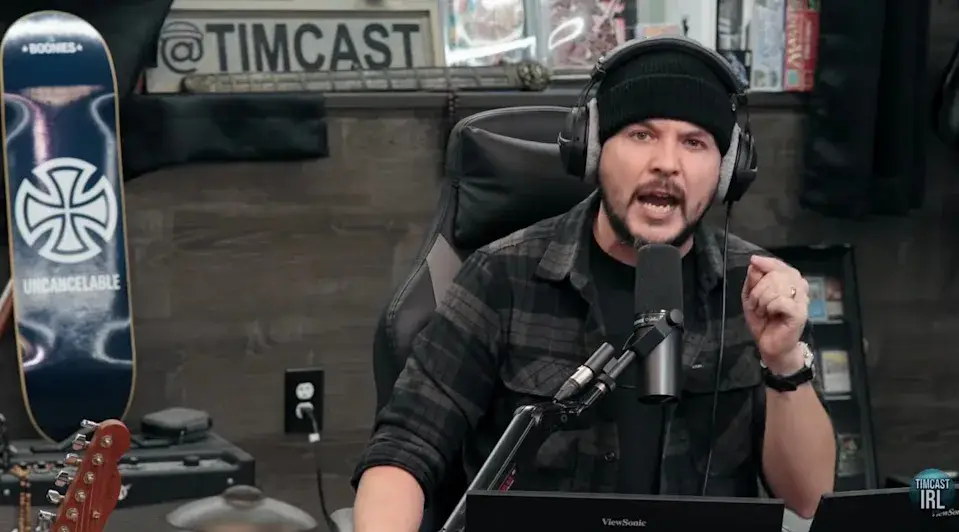
Over the weekend, political commentator Tim Pool reported that shots were fired at his house.
Before any police statement, before evidence was confirmed, before anyone even understood what happened, a familiar pattern snapped into place.
The story didn’t evolve… it detonated.
Right-leaning YouTubers, podcasters, and news outlets immediately framed the event not as a crime, but as a political attack. A symbolic act of escalation from the Left against the Right. Fox News ran with it. Benny Johnson delivered it with theatrical seriousness. Dozens of creators followed the same script:
“Assume the Worst”
“This is the beginning.”
“Arm yourselves.”
“Violence is coming.”
Whether a shooting occurred or not almost became irrelevant. The narrative had already launched, and once narratives take flight, facts are just ballast.
What happened outside Tim Pool’s home is one story.
What happened online afterward is another. And that story tells you everything you need to know about the psychological battlefield we’re living in.

The Velocity of Fear in a Polarized Ecosystem
If you watch the commentary around the incident, a pattern emerges… fast, predictable, and deeply revealing. The commentary isn’t investigative. It isn’t cautious. It isn’t analytical. It’s reactive, and more importantly, weaponized. Believe me, Trap Think hears a lot of what these commentators say — and much of it hits. But that’s exactly why the pattern jumps out at us. Familiarity isn’t confirmation; it’s a warning.
Before a single verified detail was released, the event was already being used to:
justify increased armament
validate fears of left-wing aggression
escalate the sense of imminent civil conflict
reinforce existing ideological narratives
This is what psyops look like in the modern world. Not shadowy agencies pushing false flags (which also are a thing), but the automatic, predictable hijacking of public emotions by people who do or don’t realize they’re participating.
A psyop isn’t always an intentional deception.
Sometimes it is the natural behavior of a system that rewards fear over truth.
In this case, the system rewarded:
outrage
certainty without evidence
escalating rhetoric
identity-based paranoia
emotional tribal bonding
The story became a Rorschach test. People didn’t report what they knew. They reported what they already believed. And the audience consumed it because it confirmed the fear they were already marinating in.

Why This Incident Became a Propaganda Template
In behavioral analysis, there is a phenomenon known as affective realism. This is the tendency to perceive reality in a way that matches your emotional state. You don’t react to the world as it is. You react to the world as you feel.
Once affective realism kicks in, facts aren’t filters, they’re obstacles.
The Tim Pool story shows this perfectly.
Right-wing creators framed it as a political attack before any evidence existed because that is the storyline their audiences are psychologically primed to expect. They didn’t invent a narrative… they activated one.
This is how modern information warfare works. Nobody needs to script a narrative when the public is already trained to produce it themselves.
The formula is simple:
Trigger fear
Establish an enemy
Frame yourself as the threatened group
Call for defensive escalation
This is the same sequence used in extremist recruitment, panic marketing, and cult reinforcement. No one needs to lie. They just need to hit the right emotional notes. And the audience will supply the rest.
The Self-Fulfilling Prophecy of “Get Ready for Violence”
One of the most disturbing reactions to the story is the recurring call to arm up and “prepare for what’s coming.” This phrasing is intentionally vague, emotionally charged, and psychologically potent. It turns anticipation itself into a political weapon.
Here’s the uncomfortable reality: The more you prepare for violence, the more you start seeing the world through the lens of violence.
We are advocates of the Second Amendment, and are absolutely in favor of responsible ownership and handling of firearms. Arming yourself is not wrong. Believing you’re seconds away from a political attack however… is.
Because once you adopt that belief, your nervous system starts behaving like it’s already true. When political influencers amplify these beliefs, they aren’t strengthening self-defense — they are strengthening tribal paranoia. They convert isolated incidents into narratives of existential threat.
Political psychologist Karen Stenner’s research on authoritarian tendencies is hauntingly relevant here (and yes, we’ve quoted this before):
The “threat” doesn’t need to be real. Only the emotion does.
And once the emotion hits, behavior follows. If people believe their enemies are preparing for violence, they will begin preparing too. And this is how civil conflict actually starts — not with shots fired, but with imaginations hijacked.
The Trap: When You Let Narratives Replace Reality
The Tim Pool story is a perfect Field Notes case because it reveals something essential about the modern mind: People are not responding to events. They are responding to the stories they attach to events.
That is the psyop. Not deception. But interpretation.
A real psyop doesn’t need to alter facts. It just needs to alter meaning. And meaning spreads faster and sticks deeper than any fact ever will.
This is why so many creators jumped on the same angle:
“This is proof we’re under attack.”
Not:
“Let’s wait for evidence.”
Not:
“Could there be another explanation?”
Not:
“What do we actually know?”
Fear does not wait for verification. Fear demands a villain. And the modern media ecosystem — left, right, and center — is designed to feed that fear because fear converts:
into views
into watch time
into identity
into political loyalty
into certainty
Certainty is the dopamine hit of the insecure.
Final Note: When Everyone Is Preparing for War, No One Is Thinking Clearly
We have no reason to believe shots weren’t fired as reported by Tim Pool. We can certainly take him at his word. But whether shots were actually fired is not the biggest story… the reaction is.
You can see the machinery exposed: the tribal reflexes, the emotional conditioning, the algorithmic amplification of fear, the identity threats, the self-reinforcing narratives, the escalating rhetoric, the abandonment of nuance, and the instinctive polarization that transforms any event into political fuel.
It is a psychological trap… and if you fall into it, the story stops being about Tim Pool.
It becomes a story about you.
Your fears.
Your assumptions.
Your emotional triggers.
Your willingness to believe worst-case scenarios because they validate the worldview you’ve already chosen.
Here’s the real reality check:
The moment you start preparing for violence because a YouTuber told you to, you’ve already been captured by a narrative that doesn’t care whether it’s true — only that you believe it.
And that is the essence of a psyop:
A manipulation where your mind does the work for them.